“Search the scriptures… and they are they which testify of me.” — John 5:39
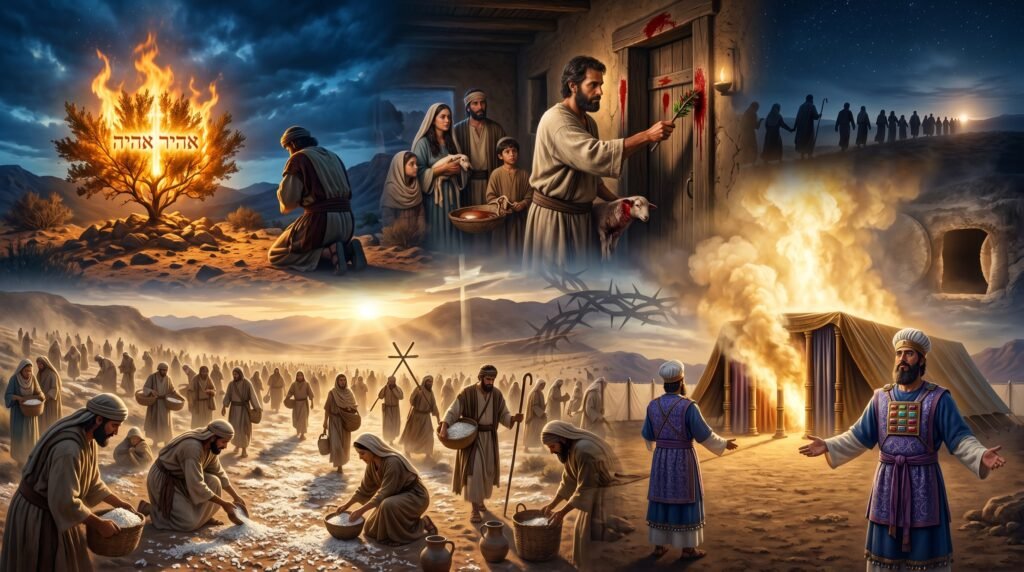
From the burning bush to the Passover lamb, from the manna in the wilderness to the glory filling the sanctuary, the book of Exodus is filled with shadows, symbols, and revelations of Jesus Christ. Long before Christ walked the roads of Galilee, Exodus was already preaching the gospel in types and illustrations. Every deliverance, every sacrifice, every priestly service, and every manifestation of God’s presence pointed forward to the coming Redeemer.
The story of Exodus is not merely about Israel escaping Egypt. It is the story of Jesus rescuing humanity from the bondage of sin. Pharaoh represents the oppressive power of Satan. Egypt symbolizes the slavery of this world. Moses acts as a mediator and deliverer pointing to Christ. The sanctuary services reveal the ministry of Jesus as our High Priest. The blood of the lamb, the rock struck in Horeb, and the bread from heaven all testify of Him.
The Jewish economy established in Exodus was “one compacted prophecy of the gospel.” Every type and shadow found its fulfillment in Christ.
Christ Revealed Throughout Exodus
Exodus 1 — Jesus the Preserver of His People
As Pharaoh sought to destroy the Hebrew children, we see a picture of Satan’s war against God’s covenant people. Yet Christ was preserving a remnant through whom the Messiah would eventually come. Even in oppression, God was preparing deliverance.
Exodus 2 — Jesus the Deliverer
The preservation of Moses in the river points to Christ’s own preservation from Herod’s decree. Moses was raised up to deliver Israel physically, while Jesus would come to deliver humanity spiritually from sin and death.
Exodus 3 — Jesus the Great “I AM”
At the burning bush, “the Angel of the Lord” appeared to Moses. This divine Messenger was Christ Himself, revealing His eternal identity. Jesus later declared, “Before Abraham was, I am” (John 8:58). The fire in the bush revealed God’s holy presence that does not consume those sheltered by His grace.
The promise, “Certainly I will be with thee,” extends to all who labor for Christ today.
Exodus 4 — Jesus the Power Behind the Signs
The miracles given to Moses revealed Christ’s authority over creation, disease, and life itself. These signs foreshadowed the miracles Jesus would later perform during His earthly ministry.
Exodus 5 — Jesus Opposed by Earthly Powers
Pharaoh hardened his heart against God’s command, just as earthly rulers and religious leaders later resisted Christ. The conflict between Moses and Pharaoh reflects the greater conflict between Christ and Satan.
Exodus 6 — Jesus the Covenant Redeemer
God revealed Himself as the faithful covenant Keeper. Christ is the fulfillment of every covenant promise made to Abraham, Isaac, and Jacob.
Exodus 7 — Jesus the True Authority Over False Gods
The plagues began exposing the helplessness of Egypt’s gods. Christ demonstrates His supremacy over every false system of worship and every power opposed to truth.
Exodus 8–10 — Jesus the Judge and Savior
The plagues revealed both mercy and judgment. Christ continually warned Egypt before judgment fell, showing God’s desire to save before He destroys.
Exodus 11 — Jesus the Coming Sacrifice
The warning of the death of the firstborn pointed forward to the coming sacrifice of God’s own Son, the Firstborn of heaven.
Exodus 12 — Jesus the Passover Lamb
This chapter is one of the clearest pictures of Christ in all Scripture.
The lamb without blemish represented Jesus, “the Lamb of God.” Its blood placed upon the doorposts symbolized the application of Christ’s blood to the believer’s heart. Israel was saved not by nationality, but by the blood.
Paul later declared: “Christ our passover is sacrificed for us.”
The Passover was both commemorative and prophetic—pointing directly to Calvary.
Exodus 13 — Jesus Our Guide
The pillar of cloud by day and fire by night represented Christ leading His people through the wilderness of this world.
Exodus 14 — Jesus the Way Through the Sea
The crossing of the Red Sea symbolizes salvation through Christ. Israel passed from slavery into freedom through a miraculous act of divine power. Their enemies were swallowed up, just as sin will ultimately be destroyed.
Exodus 15 — Jesus the Sanctuary
After deliverance came worship. Exodus reveals the Lord as the true Sanctuary established by His own hands, pointing to the heavenly sanctuary where Christ ministers today.
Exodus 16 — Jesus the Bread of Life
The manna from heaven represented Christ as spiritual nourishment for the soul. Jesus later declared:
“I am the bread of life.”
Just as Israel depended daily upon manna, believers must depend daily upon Christ.
Exodus 17 — Jesus the Smitten Rock
The rock struck in Horeb represented Christ smitten for humanity. From the wounded rock flowed water—the water of life flowing from Jesus to a dying world.
Paul plainly states: “That Rock was Christ.”
Exodus 18 — Jesus the Wise Counselor
Jethro’s counsel regarding leadership reflects Christ’s wisdom in establishing order, service, and care among God’s people.
Exodus 19–20 — Jesus the Lawgiver
Christ descended upon Mount Sinai in fire and glory to proclaim the Ten Commandments. The law is not separate from Christ—it is the expression of His own righteous character.
The same Jesus who died for sinners also spoke the law from Sinai.
Exodus 21–24 — Jesus the Mediator of the Covenant
These chapters reveal covenant principles of justice, mercy, and obedience. Moses acted as mediator between God and Israel, pointing forward to Christ, the true Mediator between God and humanity.
Exodus 23 — Jesus the Angel Before Israel
God promised to send His Angel before Israel to guide and protect them. This Angel bore the divine name within Him and represents Christ Himself leading His people.
Exodus 24 — Jesus and the Covenant Blood
The covenant was ratified with blood, pointing directly to the blood of Christ which seals the new covenant.
Exodus 25–27 — Jesus in the Sanctuary
Every article of the sanctuary revealed some aspect of Christ’s ministry:
The altar of sacrifice pointed to the cross.
The laver represented cleansing.
The candlestick symbolized Christ as the Light of the world.
The table of shewbread pointed to Christ as spiritual nourishment.
The ark represented God’s throne and law.
The earthly sanctuary was a pattern of the heavenly ministry of Jesus.
Exodus 28 — Jesus Our Great High Priest
Aaron’s priestly garments pointed to Christ’s perfect righteousness and mediatorial ministry. Jesus now ministers as our High Priest in the heavenly sanctuary.
Exodus 29–30 — Jesus the Continual Intercessor
The daily sacrifices and incense revealed Christ’s continual intercession for believers. The incense represented His perfect righteousness mingled with the prayers of His people.
Exodus 31 — Jesus the Lord of the Sabbath
The Sabbath was given as a sign of God’s creative and sanctifying power. Christ declared Himself “Lord also of the sabbath.” The Sabbath points to Jesus as Creator, Redeemer, and Sanctifier.
Exodus 32 — Jesus the Intercessor
After Israel worshiped the golden calf, Moses interceded for the people, foreshadowing Christ pleading on behalf of sinners before the Father.
Exodus 33 — Jesus the Cleft of the Rock
When Moses desired to see God’s glory, he was hidden in the cleft of the rock. This represents the believer hidden safely in Christ while beholding the glory and character of God.
Exodus 34 — Jesus Full of Mercy and Truth
God revealed His character to Moses: merciful, gracious, longsuffering, abundant in goodness and truth. These qualities were perfectly revealed in Jesus Christ.
Exodus 35–39 — Jesus Inspires Willing Service
The willing-hearted offerings for the sanctuary symbolize the cheerful surrender Christ desires from His people. True worship flows from a transformed heart.
Exodus 40 — Jesus Dwelling Among His People
When the tabernacle was completed, God’s glory filled it. This pointed to Christ dwelling among humanity and also to His heavenly ministry in the true sanctuary above.
Christ: The Substance Behind Every Shadow
Exodus teaches us that Jesus was not absent from the Old Testament—He was everywhere within it.
He was:
The Angel in the burning bush
The Passover Lamb
The Bread from heaven
The Smitten Rock
The Lawgiver on Sinai
The Cloud by day and Fire by night
The High Priest
The True Sanctuary
The Mediator of the covenant
The sacrifices, ceremonies, priesthood, and sanctuary services were never ends in themselves. They were divine illustrations pointing humanity to Christ.
The entire system of worship in Exodus testified that forgiveness, salvation, righteousness, and communion with God could only come through Jesus Christ.
When we search Exodus with spiritual eyes, we discover that the gospel did not begin in Matthew—it was already shining through the wilderness journey of Israel.
Jesus was always the center of the story.