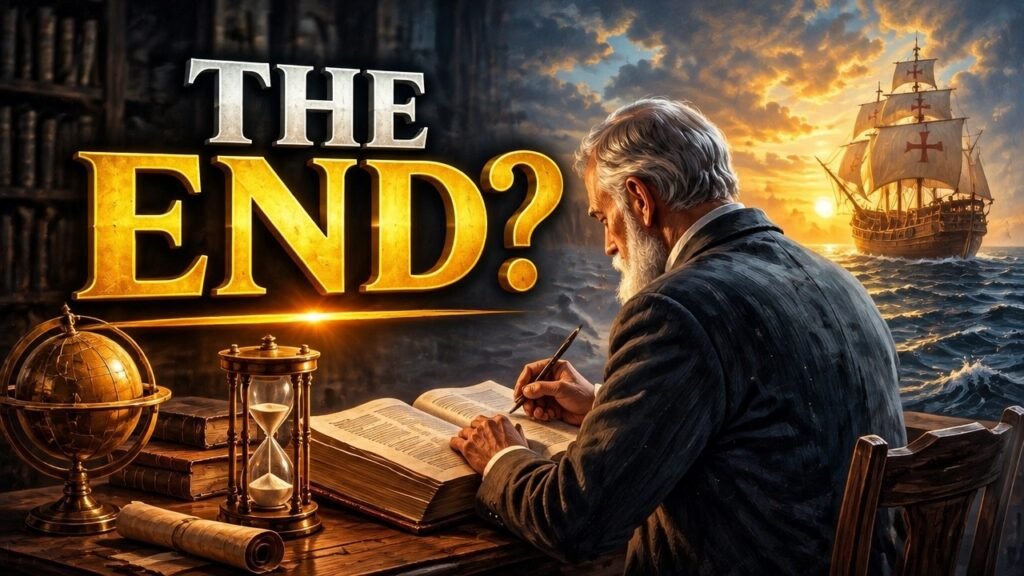
When Columbus sailed west in 1492, he had the size of the world badly wrong. He thought Japan was only about 4,000 miles from Spain, with nothing but open sea in between. He was right that the earth is round. He was wrong about how big it is, and wrong about what lay in the way.
Here's the strange part. If he'd known the real distance, he probably never would have left the harbor. One historian called his error a most fortunate one.
In 1905, the Adventist pioneer J. N. Loughborough opened his history, The Great Second Advent Movement, with that voyage. He saw in it a picture of how God's people have always traveled. Every generation since Eden has believed Christ's coming was near, and I don't think that was a failure. I think it was mercy.
I retold his first chapter in a short video, so you can watch it here or keep reading below.
One Promise Carried Out of Eden
Go back to the gate of Eden. Adam and Eve walked out with one promise, spoken to the serpent in their hearing.
"And I will put enmity between thee and the woman, and between thy seed and her seed; it shall bruise thy head, and thou shalt bruise his heel."
Genesis 3:15 (KJV)
A restorer was coming. Loughborough says they likely expected one of their own children to be that victor, and soon. God, in mercy, didn't show them the long ages of misery that lay between the ruin and the restoration. That grief would have been more than they could carry. So He left them the hope, and the hope kept them getting ready.
Every generation since has lived the same way, sure that Christ would come and sure that it was near. Like Columbus, they couldn't see what lay across the path. That's exactly why they kept sailing.
The Hope That Held Paul
"Which hope we have as an anchor of the soul, both sure and stedfast, and which entereth into that within the veil;"
Hebrews 6:19 (KJV)
Watch what that anchor did for Paul. On trial before Felix, he said he had "hope toward God" that there would be a resurrection of the dead (Acts 24:15). Before King Agrippa he asked, "Why should it be thought a thing incredible with you, that God should raise the dead?" (Acts 26:8). And in Rome, as a prisoner, he said, "for the hope of Israel I am bound with this chain" (Acts 28:20).
When he wrote to Titus, he gave the hope a name.
"Looking for that blessed hope, and the glorious appearing of the great God and our Saviour Jesus Christ;"
Titus 2:13 (KJV)
Peter called it "a lively hope" and said it holds even when faith is "tried with fire" (1 Peter 1:3, 7). So this was never a side teaching. It goes back to why God made the earth in the first place. Isaiah says "he created it not in vain, he formed it to be inhabited" (Isaiah 45:18), and the Psalms promise that "the meek shall inherit the earth" (Psalm 37:11).
More Than a Comforting Story
How do we know this is more than a nice thought to get us through hard days? Peter answers that head on. "We have not followed cunningly devised fables," he writes. He and the others "were eyewitnesses of his majesty" (2 Peter 1:16).
He's talking about the mount of transfiguration, where he saw Jesus glorified the way He will appear when He comes in His kingdom. Elijah stood there, who never died, picturing those who will be changed in the twinkling of an eye. Moses stood there, who had died, picturing those who will be raised. It was a small preview of the second coming.
And Peter still says we have something surer than what he saw with his own eyes.
"We have also a more sure word of prophecy; whereunto ye do well that ye take heed, as unto a light that shineth in a dark place, until the day dawn, and the day star arise in your hearts:"
2 Peter 1:19 (KJV)
On the mountain they heard God's voice once. In prophecy, Loughborough says, we hear it over and over. Every prediction that has already come true is a promise that the rest will follow. Jesus told His disciples the same thing: "Now I tell you before it come, that, when it is come to pass, ye may believe that I am he" (John 13:19).
Prophecy Was Never Meant to Be Sealed
This is where a lot of people stop, because they've been told prophecy can't be understood. Some say they aren't educated enough. Some of the educated say the book is sealed. John was told the opposite.
"And he saith unto me, Seal not the sayings of the prophecy of this book: for the time is at hand."
Revelation 22:10 (KJV)
Revelation even opens with a blessing on those who hear its words and keep them (Revelation 1:3). That makes no sense if nobody can understand it. And Jesus Himself said of Daniel, "whoso readeth, let him understand" (Matthew 24:15).
What it takes isn't a secret code. Prophecy came as "holy men of God spake as they were moved by the Holy Ghost" (2 Peter 1:21), and that same Spirit is promised to "guide you into all truth" (John 16:13).
Made to Fit
My favorite story in the chapter is about a skeptic who came up to Loughborough after one of his talks. The man congratulated "interpreters of prophecy" on being very fortunate, since history always seemed to fit the prophecy so neatly.
Loughborough asked him a question. If you went to a glove store to buy a pair of gloves, wouldn't you expect to find a pair that fits your hand? "Of course I would," the man said, "because they were made to fit."
That was the answer. The God who knew what men would do gave the prediction, and the honest historian simply wrote down the fit.
A Lamp, Not a Map
Peter called prophecy "a light that shineth in a dark place." A lamp doesn't show you the whole country. It shows the next step clearly enough to take it.
"Thy word is a lamp unto my feet, and a light unto my path."
Psalm 119:105 (KJV)
Proverbs adds that the path "shineth more and more unto the perfect day" (Proverbs 4:18). Along that path, Loughborough points to three events that stand above the rest:
- The birth of Christ, God manifest in the flesh.
- The Reformation, when the Scriptures came back into the hands of common people after 1,260 years.
- The second coming, still ahead, which ends the long conflict between sin and righteousness.
That day comes on the world "as a thief in the night" (1 Thessalonians 5:2). But Paul tells believers, "ye, brethren, are not in darkness, that that day should overtake you as a thief" (1 Thessalonians 5:4).
God Starts Small
The chapter ends by talking about poor people, which surprised me at first. But Loughborough knew the first objection to the advent movement. It started small, among people nobody had heard of. So he quotes the Reformation historian D'Aubigné: "To effect great results by the smallest means, such is the law of God."
Then he walks through the evidence:
- A nation began with one man, Abraham, and God told Israel they were "the fewest of all people" (Deuteronomy 7:7).
- Their deliverer was a baby hidden for three months, then set afloat on the Nile in a basket of reeds.
- Gideon called himself "the least in my father's house" (Judges 6:15), and he won with 300 men carrying lamps and pitchers.
- The Saviour was found lying in a manger, and later said He had nowhere to lay His head.
- In the Reformation, Zwingli came from a shepherd's hut, Melanchthon from an armorer's shop, and Luther from the cottage of a poor miner.
Paul had already explained the pattern.
"But God hath chosen the foolish things of the world to confound the wise; and God hath chosen the weak things of the world to confound the things which are mighty;"
1 Corinthians 1:27 (KJV)
And the prophet Zechariah asks a question that still stings: "For who hath despised the day of small things?" (Zechariah 4:10).
How Could So Few Be Right?
The other objection is about numbers. How could so few be right and so many be wrong? Luther heard that one. His opponent Eck mocked the idea that God had hidden the truth from so many saints until Luther showed up.
Zwingli heard it too, and his answer is worth remembering. Error is no less error because people have believed it for fourteen hundred years. What settles a question is whether it can be found in the Scriptures. Its age doesn't settle it, and neither does the size of the crowd that holds it.
So Loughborough asks one thing of his reader before the story begins. Don't dismiss the movement for its humble start. Weigh the evidence. He also asks us to remember, because Israel drifted when "they forgat God their saviour" (Psalm 106:21).
What This Means for You Today
Which brings us back to that ship. Columbus sailed on a wrong map and still found a world. We've been given far more than he had: a sure word, a lamp for every step, and a hope that has held as an anchor since Eden.
If you've ever felt foolish for believing Jesus is coming soon, you're in good company. Adam and Eve believed it. Paul believed it in chains. That nearness was never a miscalculation. It's the way God has kept His people watching and ready, one generation after another.
You don't need to see the whole road. Open the Word, take the step the lamp shows you today, and don't despise small beginnings, in the church or in your own walk with God. As Loughborough put it, "Truth is of inestimable value, compared with which mere opinions of men are but worthless chaff."
Chapter 2 follows that promise from Eden forward. If you'd like to travel the rest of the road with me, watch the video and subscribe so you don't miss the next one.
All Scripture quotations are from the King James Version. Quotes from Adventist pioneer writers are drawn from public domain sources, cited below.
Sources
- J. N. Loughborough, The Great Second Advent Movement, chapter 1, "Introductory," pp. 30, 33, 37 (1905)
- J. H. Merle D'Aubigné, History of the Reformation, Book II, chapter 1, as quoted by Loughborough
- J. A. Wylie, The History of Protestantism, as quoted by Loughborough (Luther and Eck, Zwingli at Zurich)
- D. H. Montgomery's American history (1902 edition), pp. 8-9, as quoted by Loughborough (Columbus)