A few years ago, Pew Research Center gave about 11,000 Americans a quiz on religion. On the questions about the Bible and Christianity, atheists and agnostics scored about as well as Christians overall.
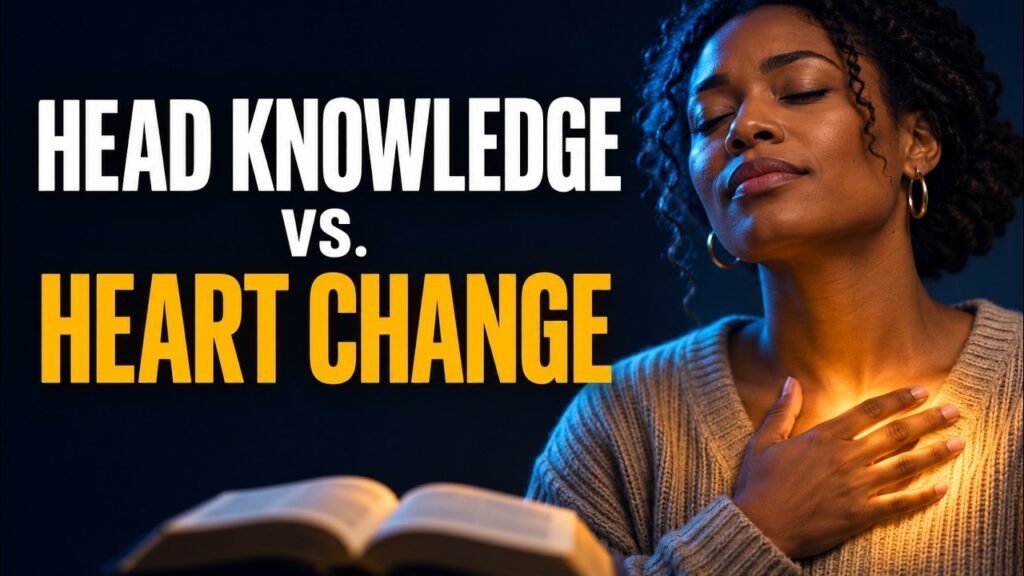
That sounds like bad news for Christians. I think it points to something far more important. You can know the facts about God without being changed by God at all.
If you're new to faith, or you're coming back after years away, this matters to you more than anyone. There's a real difference between filling your head and having your heart changed, and the second one is open to you this week, wherever you're starting from.
I made a short video on this, so you can watch it here or keep reading below.
Reading More Isn't Automatically the Answer
The Bible isn't hard to find. In 2025 the American Bible Society counted about 110 million American adults who open it on their own. Inside the church the picture is more mixed. An older Lifeway study found that only 19% of churchgoers read the Bible every day, and almost the same share, 18%, said they rarely or never do.
You'd expect me to say, "So read it more." But here's the part nobody warns you about. The Bible itself describes people who read it constantly and still missed everything.
Start with one of the most uncomfortable verses in the New Testament.
"Thou believest that there is one God; thou doest well: the devils also believe, and tremble."
James 2:19 (KJV)
The devils have correct information about God, and it has never changed them. So correct information can't be the finish line. If it were, they would have crossed it long ago.
The Experts Who Missed Him
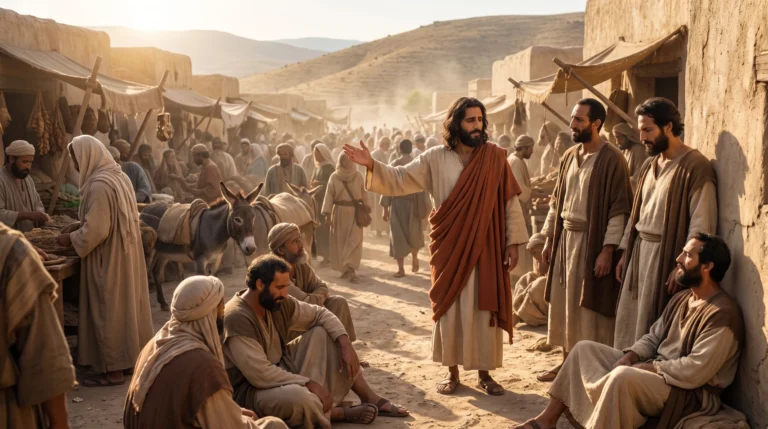
Now move from the devils to the most serious Bible students of Jesus' day. These men studied the Scriptures for a living. Jesus looked at them and said:
"Search the scriptures; for in them ye think ye have eternal life: and they are they which testify of me. And ye will not come to me, that ye might have life."
John 5:39-40 (KJV)
They were holding the map. They were standing right next to the destination. And they kept staring at the map.
Jesus takes it even further in the Sermon on the Mount, where He describes people who did impressive religious work in His name.
"Many will say to me in that day, Lord, Lord, have we not prophesied in thy name? and in thy name have cast out devils? and in thy name done many wonderful works? And then will I profess unto them, I never knew you: depart from me, ye that work iniquity."
Matthew 7:22-23 (KJV)
Notice the words He chose. He didn't say, "You never knew enough about Me." He said, "I never knew you." The question was never about a score. It was always about a relationship.
Nicodemus Didn't Need More Information
So what happens when an expert meets Jesus face to face? John tells us about Nicodemus, a respected Pharisee and a ruler of his people. He comes to Jesus at night and opens politely with what he already knows. Jesus goes straight past the compliment.
"Jesus answered and said unto him, Verily, verily, I say unto thee, Except a man be born again, he cannot see the kingdom of God."
John 3:3 (KJV)
Nicodemus is confused, and Jesus asks him, "Art thou a master of Israel, and knowest not these things?" (John 3:10). Ellen White put Jesus' meaning this way:
"It is not theoretical knowledge you need, so much as spiritual regeneration."
Ellen G. White, The Desire of Ages, p. 171
In plain words, Nicodemus didn't need more information. He needed a new beginning, and he couldn't get one by studying harder. God had promised that kind of beginning centuries earlier through the prophet Ezekiel.
"A new heart also will I give you, and a new spirit will I put within you: and I will take away the stony heart out of your flesh, and I will give you an heart of flesh."
Ezekiel 36:26 (KJV)
That isn't a promise of better notes. It's a promise of surgery.
Saul Stopped Knowing About Jesus From a Distance
If you want to see that surgery happen to a real person, look at Saul of Tarsus. Saul was a Pharisee who trained "at the feet of Gamaliel" (Acts 22:3), one of the most respected teachers of his time. Nobody could question his record. And he used all that knowledge to hunt down Christians.
Then, on the road to Damascus, a light from heaven stops him.
"And he said, Who art thou, Lord? And the Lord said, I am Jesus whom thou persecutest: it is hard for thee to kick against the pricks."
Acts 9:5 (KJV)
He gets up blind. For three days he doesn't eat or drink, and the expert has to be led by the hand into the city (Acts 9:8-9).
Years later, writing as the apostle Paul, he looked back at that perfect record and made a stunning decision about it.
"Yea doubtless, and I count all things but loss for the excellency of the knowledge of Christ Jesus my Lord: for whom I have suffered the loss of all things, and do count them but dung, that I may win Christ,"
Philippians 3:8 (KJV)
He stopped knowing about Jesus from a distance and started knowing Him personally.
Being a Beginner Is Not a Disadvantage
This is where the story turns toward you. Maybe you feel behind because you don't know where Habakkuk is. Maybe you stopped reading years ago and you're embarrassed to start again.
Look at who got it wrong in the stories we just read. It wasn't the beginners who missed Jesus. It was the experts who thought they had already arrived.
So being new doesn't put you behind. You have nothing to protect, which means you can come to the Bible hungry instead of proud. The trouble only starts when the Book becomes the goal instead of the road.
Three Ways to Turn Reading Into Eating
How do you move from knowing about God to being changed by Him? The answer starts with a very ordinary picture: a plate of food.
"Food cannot benefit us unless we eat it; unless it becomes a part of our being. So Christ is of no value to us if we do not know Him as a personal Saviour. A theoretical knowledge will do us no good."
Ellen G. White, The Desire of Ages, p. 389
You can read every recipe in the kitchen and still go to bed hungry. Here are three things that turn reading into eating.
1. Ask for Help Before You Read
You can't do this part alone, and you were never meant to.
"One may be familiar with the commands and promises of the Bible; but unless the Spirit of God sets the truth home, the character will not be transformed."
Ellen G. White, Christ's Object Lessons, p. 408
So begin with one short, honest prayer. Ask God to show you Himself. It doesn't need to be longer than that.
2. Slow Down and Stay With Him
The Bible is about a Person, and you don't get to know a person by skimming.
"But we all, with open face beholding as in a glass the glory of the Lord, are changed into the same image from glory to glory, even as by the Spirit of the Lord."
2 Corinthians 3:18 (KJV)
We're changed by beholding. So don't race through chapters. Stay with one story of Jesus until you can picture it.
3. Do One Thing With What You Read, the Same Day
"But be ye doers of the word, and not hearers only, deceiving your own selves."
James 1:22 (KJV)
If the passage is about forgiveness, text the person you need to forgive. And try to keep at it for most of the week, not just once. Researchers at the Center for Bible Engagement found that the link between Bible reading and daily life jumps at four or more days a week.
To be fair, research like that shows a link. It can't prove what causes what. But it fits everything we've just read. The answer was never to close the Book. It was to meet the Person it's about.
What This Means for You Today
Go back to that survey for a moment, because now it means something different. A test can measure what you know about God. It can't measure whether you're more patient than you were last year. Those answers don't go on a score sheet. They show up in your life.
So tonight, pick one short story of Jesus. Say one honest prayer. Then do one small thing the story asks of you.
You don't need to know where Habakkuk is to start. You only need to come hungry, because the One the Book points to is already coming toward you.
If you're starting over today, leave the word "hungry" in the comments on the video, and I'll be praying for you.
All Scripture quotations are from the King James Version. Quotes from Ellen G. White and other Adventist pioneer writers are drawn from public domain sources, cited above.
Sources
- Ellen G. White, The Desire of Ages, pp. 171, 389 (1898)
- Ellen G. White, Christ's Object Lessons, p. 408 (1900)
- Pew Research Center, "What Americans Know About Religion" (2019)
- American Bible Society, State of the Bible USA 2025
- Lifeway Research, Transformational Discipleship study (2012)
- Center for Bible Engagement, "Understanding the Bible Engagement Challenge: Scientific Evidence for the Power of 4" (2009)